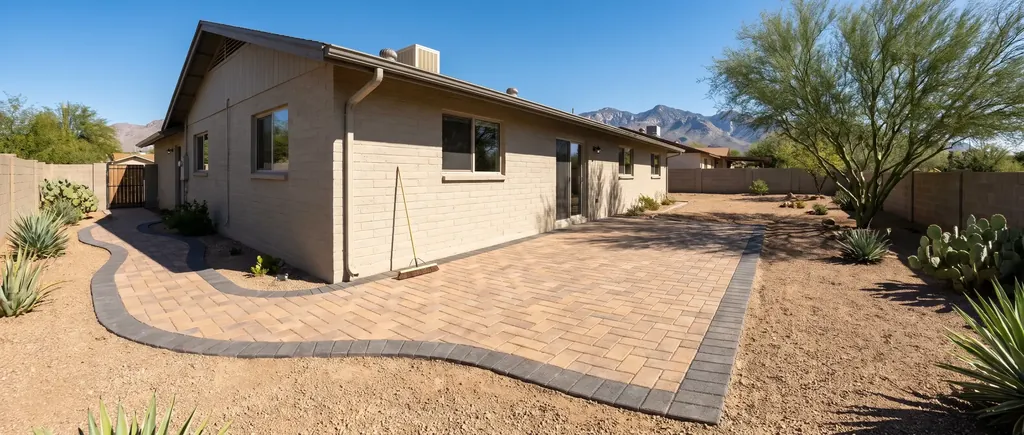
Paver installation
Interlocking paver surfaces for patios, drives, paths and pool decks, built on a base sized for the job it has to carry.
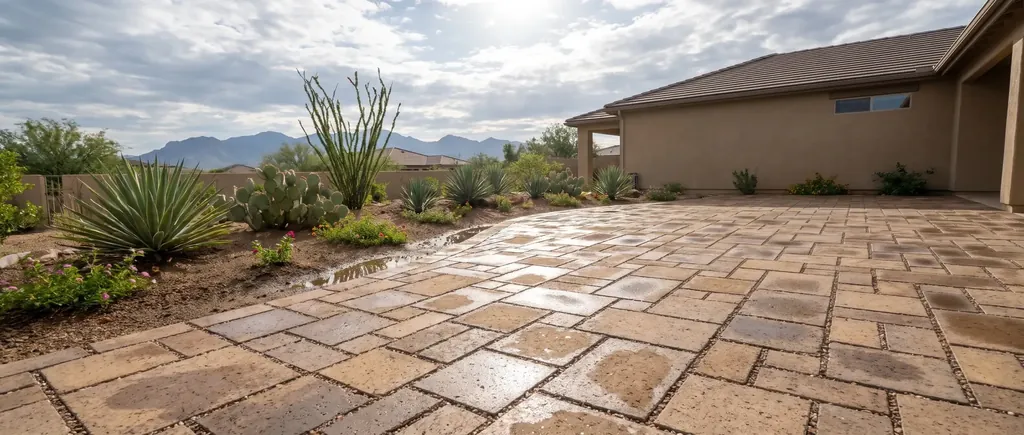
When a summer storm drops heavy rain in a short burst, ordinary paving sends it all somewhere else. Permeable pavers let that water drop through open joints into a stone base below, where it can soak in slowly instead of sheeting across the yard.
A standard paver surface is built to shed water. The joints are packed with sand and the whole surface is pitched so rain runs off the edge. That works, but on a lot with little fall, or where runoff already floods a side yard or pools against a wall, it can make the problem worse.
A permeable paver system works the other way. The pavers are made with wider spacers, and the joints are filled with small, clean crushed stone rather than sand. Under them sits a deep base of open graded stone with no fine material in it, which leaves empty space between the rocks. Rain passes through the joints, collects in that space and drains down into the soil at its own pace.
The catch in Tucson is caliche. Where a hard layer sits close to the surface, water cannot drain into the ground quickly, so we check the soil before recommending this system. On some sites the base needs an overflow route or an underdrain, and on a few the honest answer is that standard pavers with good grading will serve you better.
Back yard patios on flat lots, or patios next to the house where there is nowhere for surface runoff to go.
Permeable driveway pavers on a deeper reservoir base, sized for the weight of vehicles as well as the volume of water.
Narrow side yard runs where storm water collects between the house and a block wall, and paths through planting that should stay dry underfoot.
Checking the soil, how deep any caliche sits, where water comes from during a storm and where overflow can safely go.
Digging deeper than a standard paver job, laying geotextile where it is needed, and placing open graded stone in compacted layers.
Setting permeable pavers on a stone bedding layer and filling every joint with clean chip stone instead of sand.
Fixing restraint around the perimeter, compacting the surface, and showing you how to keep the joints clear of dust and debris.
We look at the slope, the soil and the path storm water takes across the property today.
We tell you plainly whether permeable paving suits the site, or whether a standard paver surface with better grading is the smarter build.
We settle the area, paver, base depth and overflow plan, then put the full scope in writing.
We call in utility locates before digging and prepare anything your HOA asks to review.
Excavation, fabric, reservoir base, bedding stone, pavers, joint fill, restraint and compaction.
We walk the finished surface with you and explain the simple upkeep that keeps the joints draining.
We start with the dirt, not the brochure. A permeable system only works if the ground below it can take the water, so we review the soil and the drainage before we recommend one.
We also build the base the system needs. Permeable paving lives or dies on clean, open stone in the right depth, and we do not substitute a standard base to save time.
Tell us where water collects on your property, and we will come out to check whether permeable pavers are the right fix.
The most common is permeable interlocking concrete pavers, which look like standard pavers but have wider joints filled with stone. Others include grid pavers, open cells filled with gravel or turf, and poured surfaces such as pervious concrete and porous asphalt. For homes, permeable interlocking pavers are what we install most.
A little water gets through the sand joints of standard pavers, but they are designed to shed rain off the surface. Permeable pavers are built to let water through, with open stone joints and a stone base that holds water while it soaks into the soil.
For standard pavers, polymeric or washed joint sand. For permeable pavers, small clean crushed chip stone, because sand would clog the joints and stop water getting through.
Clean, open graded crushed stone with the fines washed out, placed in compacted layers: a deeper reservoir course at the bottom, smaller stone above it, and a stone bedding layer for the pavers. Geotextile goes in where the soil calls for it, and where caliche slows drainage we add an overflow route or underdrain. The depth is set by the soil and by whether vehicles will cross it.
Usually not up front, and permeable systems typically cost more than standard pavers because of the deeper excavation and extra stone. The drivers are area, base depth, soil conditions, overflow needs and access. We price it after a free site visit.
We install permeable pavers across Tucson and the surrounding communities, including Oro Valley, Marana, Catalina Foothills, Casas Adobes, Vail, Sahuarita, Green Valley, Rita Ranch and Tanque Verde.
Interlocking paver surfaces for patios, drives, paths and pool decks, built on a base sized for the job it has to carry.
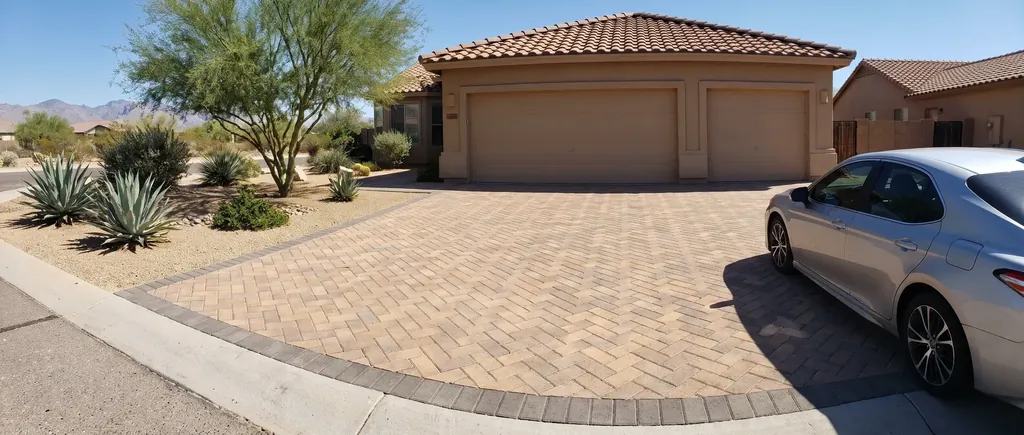
Driveways built to a vehicle load base, laid in a pattern that locks under turning tires and lifts out cleanly for repairs.
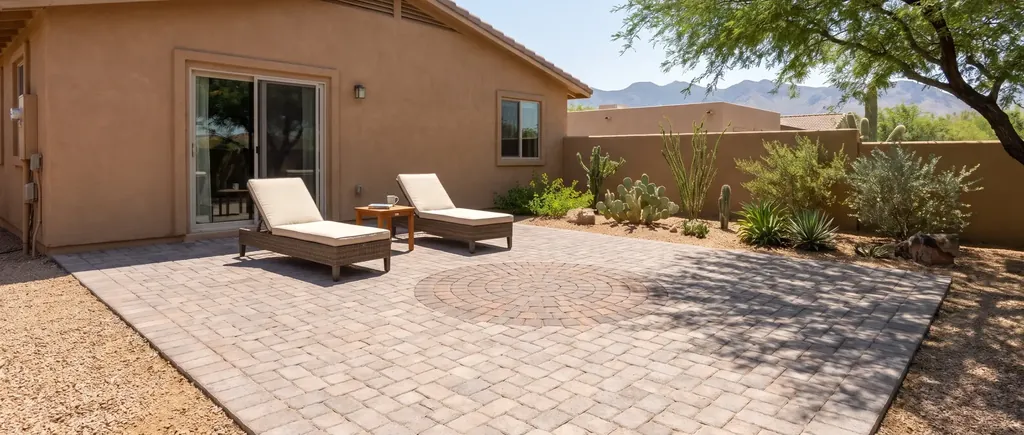
Interlocking paver patios with a compacted base, a restrained edge and a steady fall away from the house.
Give us a rough size, describe the current surface, and tell us where water pools after a storm. We will come out, check the soil and send a written estimate.
We will be in touch to set a time to visit. If it is urgent, call (520) 555-0153.