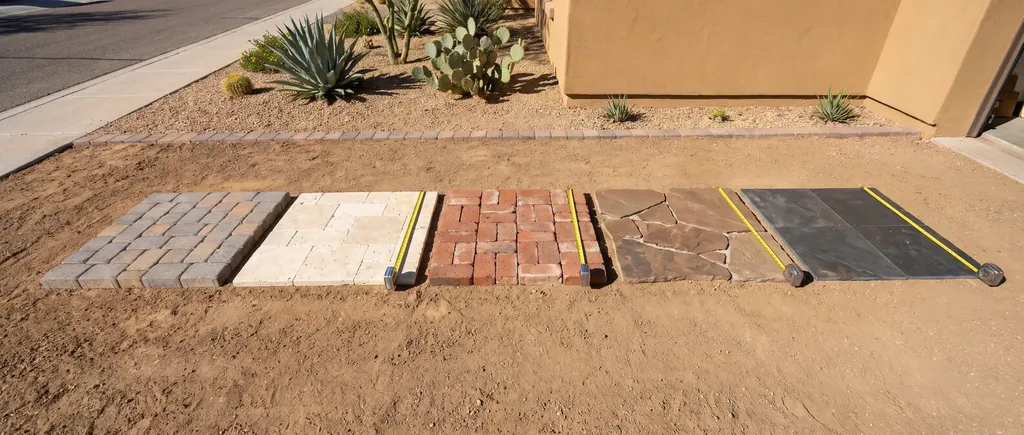
Paver types and materials
Concrete, travertine, brick, flagstone and other natural stone compared on heat, wear, upkeep and where each one belongs.
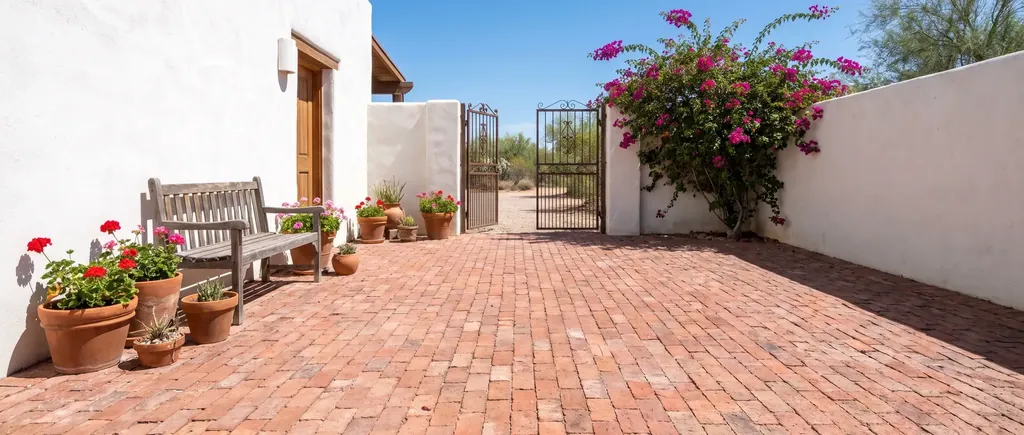
Fired clay brick has a warmth that suits Tucson's older homes and territorial style courtyards. We lay clay brick pavers for entries, courtyards, paths and borders, on a compacted base and in patterns that keep every line true.
A clay brick paver is shaped from clay and fired in a kiln. The color comes from the clay itself, so it runs all the way through. Scuff it, chip it or wear it down over the years and the same red, rust or brown is still there underneath. That is why an old brick courtyard tends to look better with age rather than worse.
Brick pavers are smaller and more uniform than most stone, which makes them ideal for the classic patterns: herringbone, basket weave and running bond. They also make an excellent border around a field of concrete pavers or travertine, giving a patio or driveway a crisp frame.
The installation is the same discipline we bring to every surface. The ground is excavated, the subgrade compacted, and aggregate base placed in compacted layers, with caliche dealt with along the way. Brick then goes down on a screeded sand bed, restrained at the edges and locked with joint sand.
We keep the scope honest. Clay brick costs more than standard concrete pavers and comes in a narrower range of shapes. For a busy driveway we usually recommend concrete pavers instead, sometimes with a brick border for the look.
Entry walks and enclosed courtyards in herringbone or basket weave, where the brick ties in with block, stucco or adobe walls.
Brick paver walkways through planting and gravel, with a soldier course on each side to hold the line.
Brick edging around concrete paver or travertine patios, and banding across larger areas to break up the field.
Help choosing a brick blend and a pattern that suits the house and the use.
Excavation, subgrade compaction and aggregate base built in compacted lifts with a fall away from the house.
Brick laid to string lines on a screeded sand bed, with border and step cuts made on a wet saw.
Edge restraint on open sides, joint sand swept in and the surface compacted with a protective pad.
We measure, check drainage and look at how the brick will meet walls, doors and existing paving.
We show you brick samples and patterns side by side.
A written scope covering removal, base, brick, pattern and borders.
We set a start date and call in utility locates before digging.
Excavation, base, bedding, laying, cutting, restraint and joint sand.
We walk the finished work with you and leave spare brick for repairs.
We lay brick for the long term, on a real base rather than a skim of sand over dirt. We will also tell you when brick is not the right call, and point you to the material that is.
Tell us where you are picturing it and we will come out to talk through patterns and colors.
It depends on the brick you choose, the pattern, how much has to be removed, base depth and how many cuts the shape needs. Herringbone and curves take more cutting than running bond. We give a written estimate after seeing the site.
Compacted crushed aggregate base over compacted native soil, then a thin screeded layer of coarse sand. The aggregate carries the load and the sand beds the brick.
For the base, no. A hand tamper cannot reach the density a plate compactor gives, and a base that is not dense settles. We compact every layer with a plate compactor.
Joint sand. Fine dry sand works, and polymeric sand, which hardens once wetted, holds better against wind and ants. We pick the right one for your joints and use.
Yes, in most cases. The bedding sand should be a thin, even layer of about an inch. A thicker bed can shift and leave the surface uneven, so the base, not the sand, should do the leveling.
We lay brick pavers across Tucson and the surrounding communities, including Oro Valley, Marana, Catalina Foothills, Casas Adobes, Vail, Sahuarita, Green Valley, Rita Ranch and Tanque Verde.
Concrete, travertine, brick, flagstone and other natural stone compared on heat, wear, upkeep and where each one belongs.
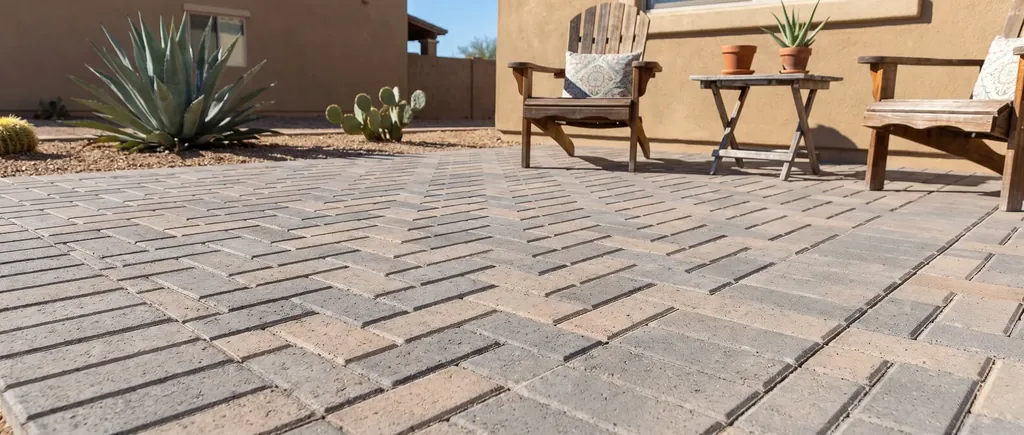
Manufactured interlocking pavers in the widest range of shapes and colors, and the strongest choice for driveways.
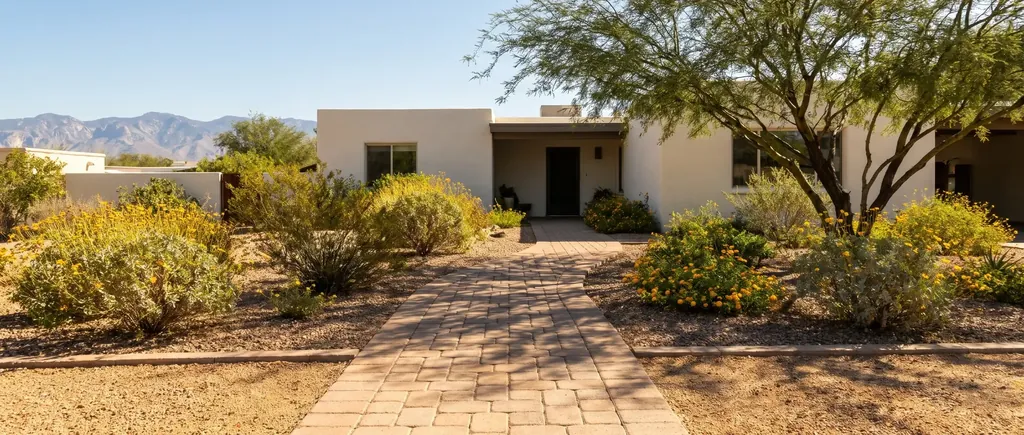
Front entries, side yard runs and garden paths with straight edges that stay straight against gravel and planting.
Share the rough dimensions and what surface is there today. We will come out, look at the space and send a written estimate.
We will be in touch to set a time to visit. If it is urgent, call (520) 555-0153.