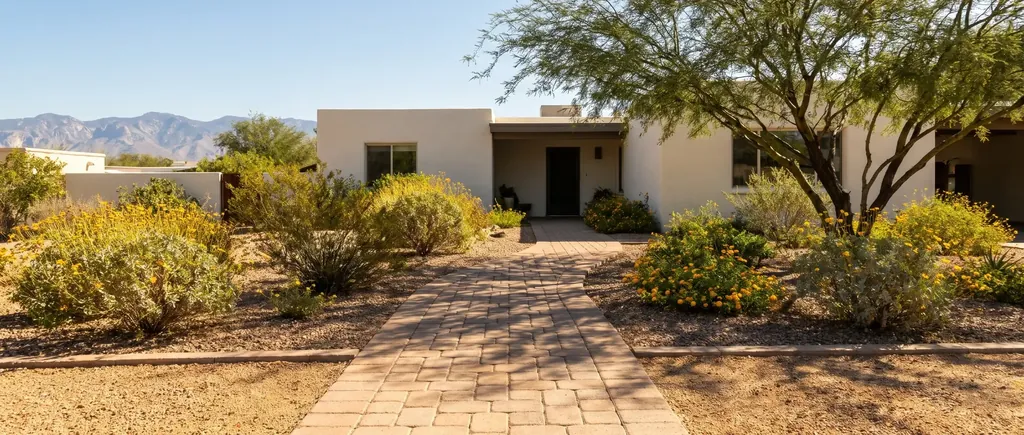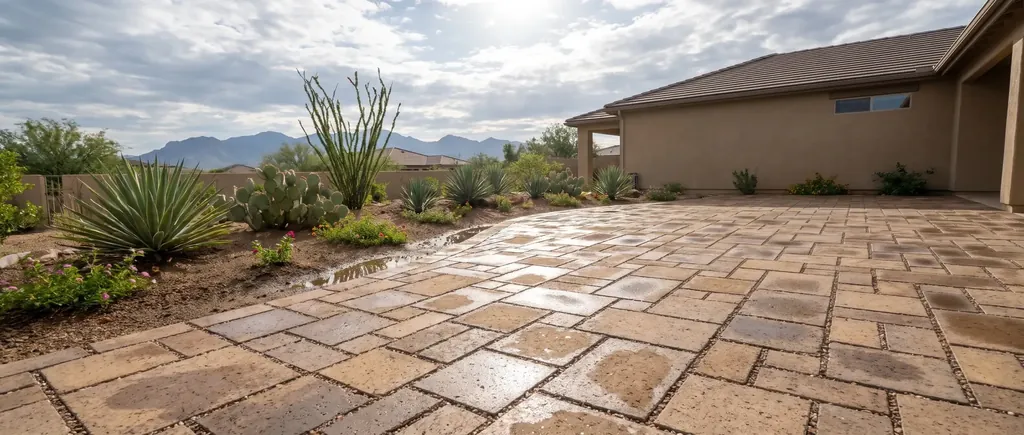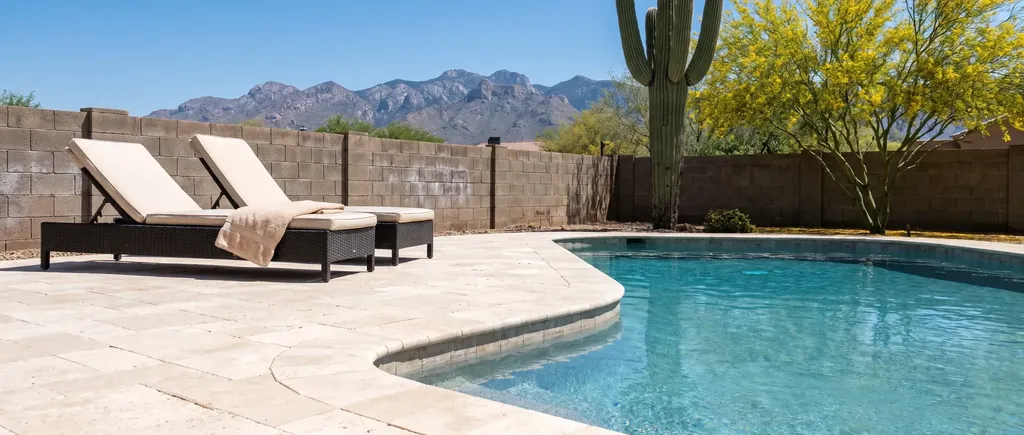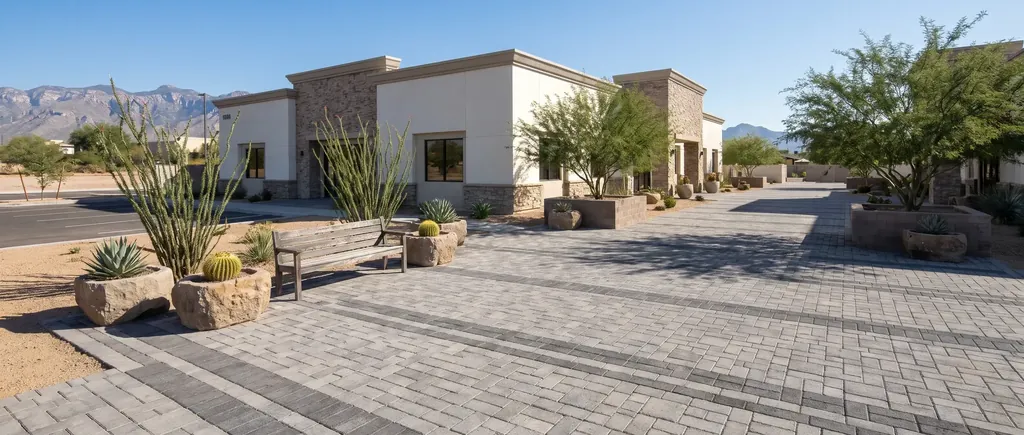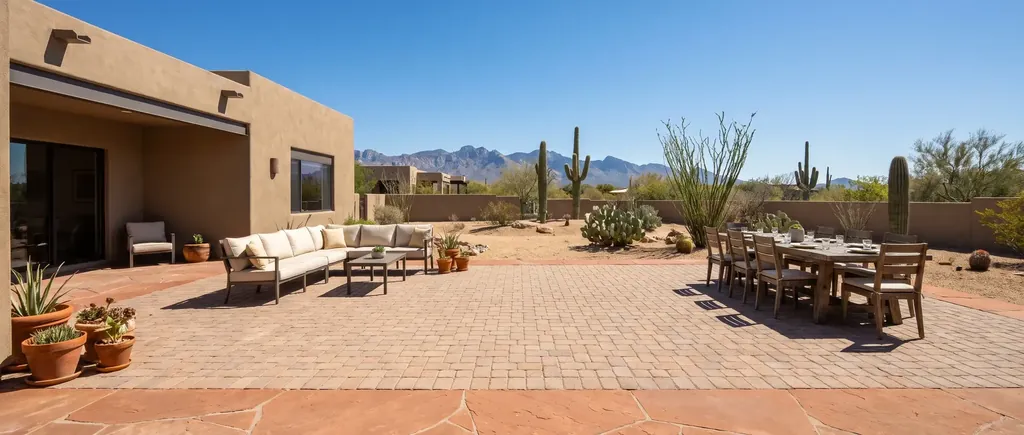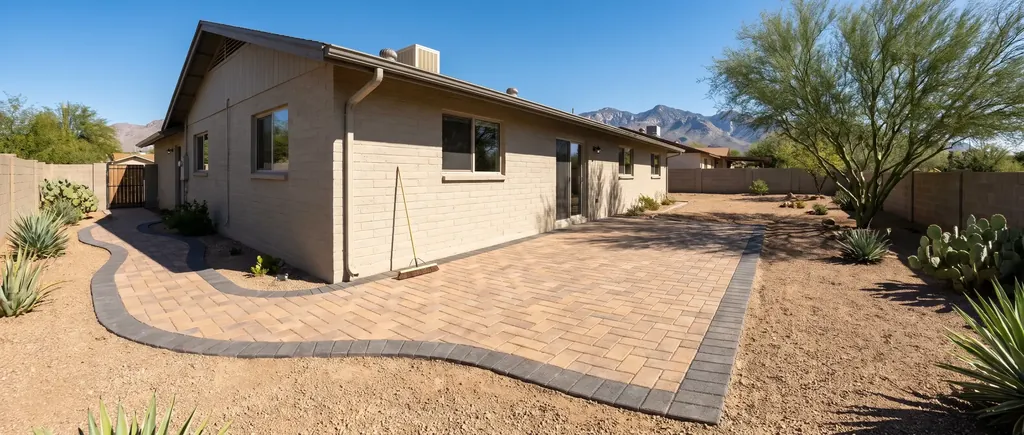
Newly installed interlocking paver surface running from a Tucson patio to a side yard path

Paver Installation in Tucson, From Base to Final Joint

We install interlocking pavers for patios, driveways, walkways, pool decks and commercial entries across the Tucson metro. The paver you see is the last step. The base under it is what decides whether it stays flat.

  • Licensed and insured
  • Base depth matched to the load
  • Compacted in lifts, not in one pass
  • Fixed edge restraint on every border
  • Free on-site estimate and level check

What professional paver installation actually involves

A paver surface is a system, and the pavers are only the top layer of it. Under every square foot we install there is a compacted subgrade, a layer of crushed aggregate base, a thin screeded bedding course, and a restraint along every edge that keeps the field from spreading. Leave out any one of those and the surface starts to move, usually within the first monsoon season.

That is why our custom paver installation services start with questions about the ground, not the catalog. What will the surface carry: people and chairs, a pool crowd, or a delivery truck? Where does the roof drain now? Is there caliche a few inches down, or soft fill left over from a pool dig? The answers set how deep we excavate, how thick the base gets, which paver thickness and pattern we use, and how the edge is held.

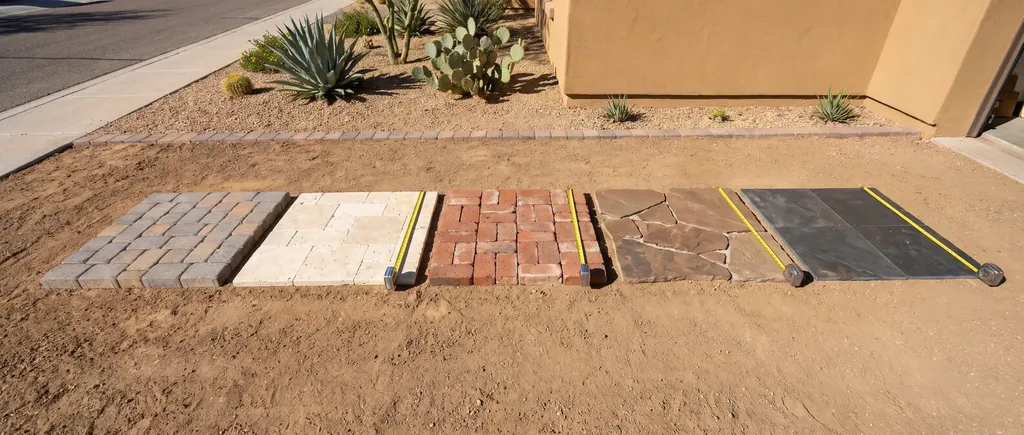
Once the base is right, the choice of paver becomes the fun part. Concrete, travertine and clay brick all lay well on the same kind of base, and the right one depends on heat, use and the look of the house.

Building a paver base on Tucson caliche

Caliche is a cemented layer of calcium carbonate that sits under much of the Tucson valley, sometimes inches below the surface and sometimes several feet down. It is hard to dig and it barely drains. Water that soaks through a paver base and hits caliche has nowhere to go, so it sits there and softens the layer above it.

We deal with it on each site as we find it. Where caliche is shallow, we excavate through or into it so the full base depth fits, and we make sure the subgrade slopes so trapped water has a way out. Where the native soil above it is loose, we compact it before any aggregate goes in. Base material is then placed in thin lifts, each compacted with a plate compactor before the next goes on, because one thick layer compacted from the top never gets dense at the bottom.
Pitch and drainage for monsoon storms

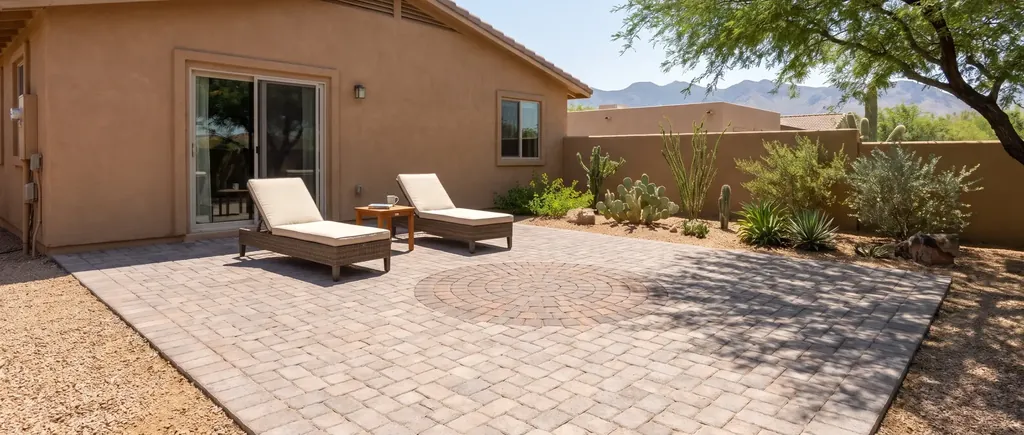
A Tucson summer storm can drop a lot of water in a very short time. A paver surface has to shed that water away from the house and off the paving without washing out the joint sand. We set a steady fall across every surface, away from walls and doors, and check where downspouts and roof valleys already discharge. When water has to cross a patio or a walkway, we plan where it leaves and what it lands on, whether that is gravel, a planting bed or a channel.

On flat lots with little natural fall, or where a client wants the water to stay on the property, permeable pavers over a deep stone reservoir are often the better answer.

Heat, expansion and the right paver for outdoor use

Outdoor pavers in Tucson spend months at surface temperatures that would soften a lot of materials. Concrete, clay and natural stone all handle the heat; what differs is how hot they feel and how much they glare. Lighter colors and travertine stay more comfortable underfoot, which matters for backyard pavers around a pool or a play area. Because pavers sit as individual units with sand joints, they move with daily heating and cooling instead of cracking the way a long poured slab can.

Paver installation work we take on

  • Paver patios

    Back patios and side yard sitting areas laid in interlocking pavers, pitched off the house and held by a pinned border.

  • Driveway pavers

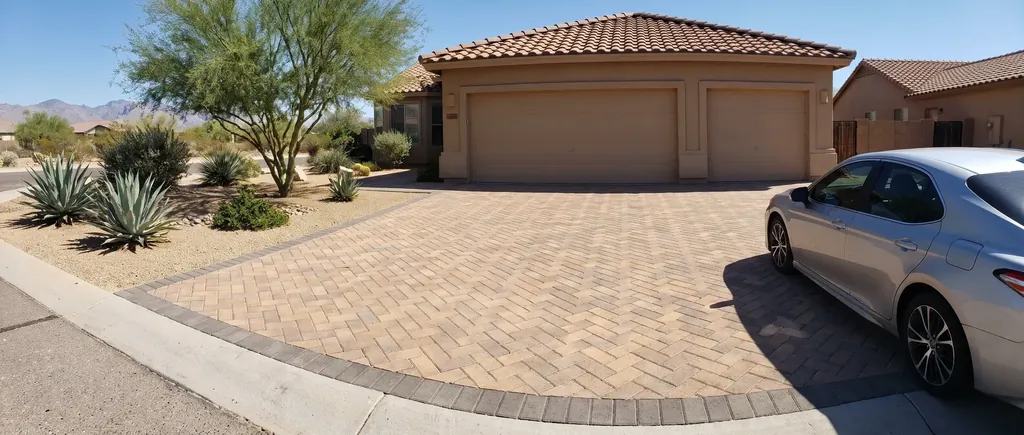
    Paver drives on a deeper, vehicle rated base, laid in herringbone so turning tires cannot push the field apart.

  • Paver walkways

    Entry paths and garden runs set to a consistent width, with borders that keep gravel and soil out of the joints.

  • Permeable pavers

    Open jointed paving over a stone reservoir, for yards where storm water needs somewhere to soak in.

  • Pool deck pavers

    Pool surrounds in pavers or travertine, chosen for grip and surface heat and pitched away from the water line.

How a paver installation runs

  1. 1. Site visit and level check

    We walk the area, take levels, probe the soil, find the downspouts, and check how equipment will get in.

  2. 2. Layout, paver and pattern

    We mark out the shape, talk through paver type, color, pattern and border, and bring samples so you can see them in your own light.

  3. 3. Written estimate

    Your scope lists removal, excavation depth, base thickness, paver, pattern and edge restraint.

  4. 4. Utility locates

    We call in locates before any digging so buried lines are marked.

  5. 5. Install

    Excavate, compact the subgrade, place and compact base in lifts, screed the bedding, lay, cut, restrain, sand and compact.

  6. 6. Walkthrough

    We walk the finished surface with you, explain how the joint sand will settle, and leave spare pavers for future repairs.

What sets the best paver installers apart

If you are searching for the best paver installers near you, the most useful thing to ask any contractor is how deep they will excavate and how thick the compacted base will be. Most paver failures trace back to too little base, or to base that was dumped and compacted once from the top. We put those numbers in writing on every estimate.

We also treat the edge as part of the structure. A paver field without a fixed restraint creeps outward over time, joints open, and the border starts to wander. Any open edge, one with no wall or slab beside it, gets restraint spiked down along its full length.

And as backyard paver contractors, we plan for access. Many Tucson back yards are reached through a narrow side gate, so we size equipment and stage materials to protect the rest of your yard while we work.

Ready to plan your paver installation?

Tell us what you want to pave and what is there now, and we will come out to check the levels and the soil.

Paver installation questions

Is it better to lay pavers on sand or concrete?

For most Tucson patios, walkways and driveways, pavers belong on a compacted aggregate base with a thin sand bedding course. That system drains, flexes and can be repaired. Setting pavers on a concrete slab makes sense mainly when a sound slab is already there and its height and drainage work, and the approach changes so water does not get trapped between the two.

What is the best base to put under pavers?

Crushed aggregate base, the angular kind that locks together when it is compacted, placed in thin layers over a compacted subgrade. Rounded gravel or plain fill does not lock and will shift. On top of the base goes a thin, level bedding layer of coarse sand for the pavers to seat into.

Is 3 inches of paver base enough?

It can be for a light walkway on firm soil, but it is rarely enough for a patio that sees regular use and is never enough for a driveway. The right depth depends on the soil and the load, which is why we set it after seeing the site and state it on the estimate.

Can I skip the gravel and just use sand under pavers?

Not if you want the surface to stay flat. Sand alone shifts and washes out, especially under monsoon runoff, and the pavers sink unevenly. The aggregate base is what carries the load; the sand layer only gives each paver an even bed to sit in.

What are common mistakes to avoid when laying pavers?

Too little base, base compacted in one thick layer, no fall away from the house, no edge restraint, and a sand bedding layer laid too thick. Each one shows up later as dips, rocking pavers, standing water or a border that drifts.

Where we install pavers

We install pavers across Tucson and the surrounding communities, including Oro Valley, Marana, Catalina Foothills, Casas Adobes, Vail, Sahuarita, Green Valley, Rita Ranch and Tanque Verde.

More of our work

  • Patio construction

    Patios planned and built as outdoor rooms, laid out around doors, sun, shade and how you actually use the yard.

  • Paver types and materials

    Concrete, travertine, brick, flagstone and cut stone compared on heat underfoot, wear, upkeep and where each fits.

Get a free paver installation estimate

Tell us what you want to pave, roughly how big it is, and what is on the ground now. We will come out, check the levels and send a written estimate.

  • (520) 555-0153
  • Mon to Fri, 7am to 4pm. Saturday estimates by appointment.
  • Licensed and insured

We call or text to set up the site visit.

For example "about 20 by 20" or "two car driveway".

Call (520) 555-0153Free estimate